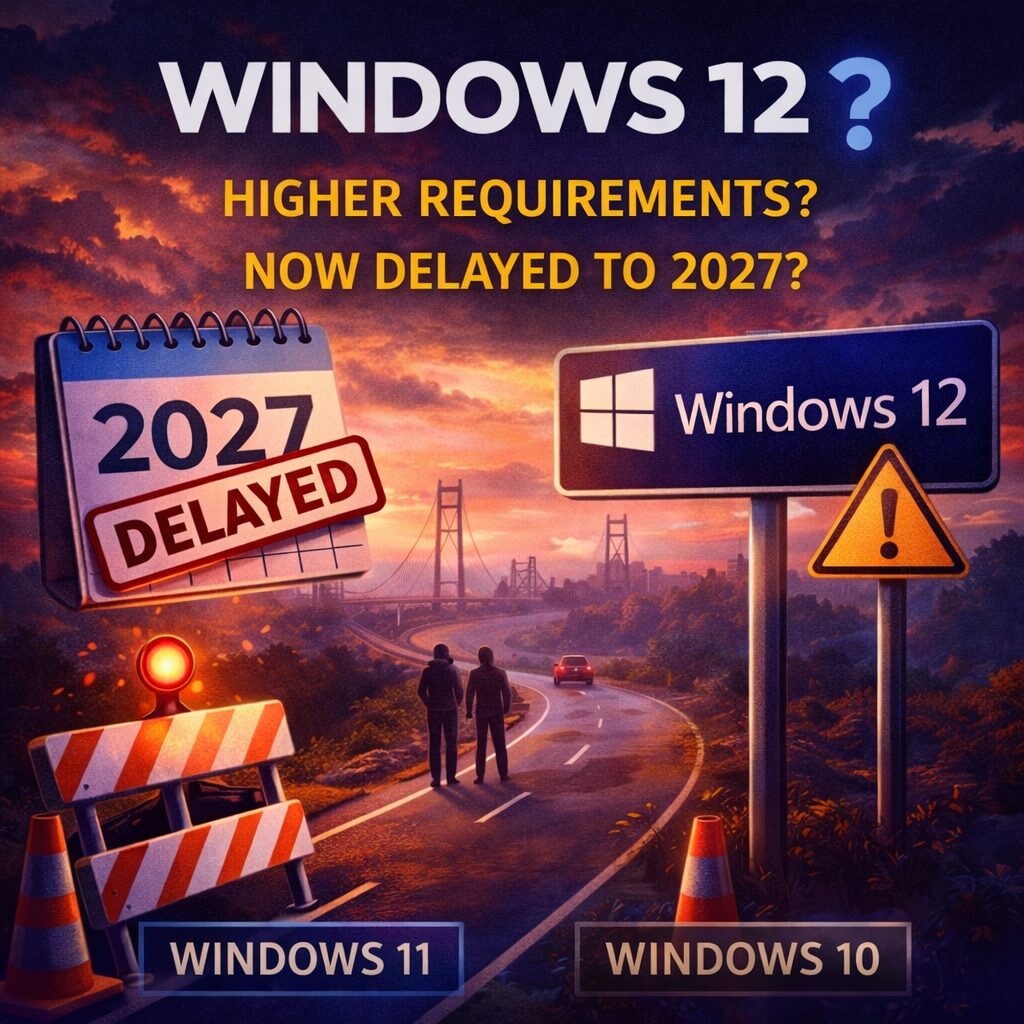
Windows 12 is still unconfirmed as of late 2025. Microsoft hasn’t announced a release date, requirements, or even the final name. However, multiple reports and rumor trackers now point to a later launch window (often “2027”) and higher hardware baselines, largely driven by Microsoft’s push toward AI features and Copilot+ class devices.
If you’re deciding what to do today, don’t bet your security and productivity on rumors:
- If your PC supports Windows 11, upgrading sooner can be the safer move.
- If your PC can’t run Windows 11, Windows 10 support has already ended—so you should plan your next step carefully (ESU, hardware refresh, or a supported migration path).
- Either way: keep licensing clean and predictable (Windows 10/11 genuine keys), because “waiting for Windows 12” is not a plan.
Table of Contents
1) What we actually know about Windows 12 (as of Dec 2025)
Let’s start with the boring truth: there’s no official Windows 12 announcement you can plan around.
What is official and visible is Microsoft’s current direction:
- Windows 11 continues with an annual feature update cadence, not a “new Windows every year” model.
- Microsoft is actively shipping and maintaining Windows 11 updates (including 25H2-era lifecycle communications), which supports the idea that Windows 11 is still the main platform for now.
So, treat “Windows 12” as speculation until Microsoft publishes a product announcement, lifecycle, and hardware baseline.
2) “Windows 12 got postponed again”: why people now say 2027
If you’ve been following this space, you’ve seen the timeline move:
- Earlier rumor cycles suggested “Windows 12” could show up around the Windows 10 end-of-support window.
- More recent reporting (including Spanish-language coverage and English rumor trackers) shifts the expectation to 2027 and frames it as another “not yet” moment.
Why does the rumor window keep sliding?
- Windows 11 is still being extended via annual updates rather than replaced quickly.
- Microsoft’s messaging and product strategy are heavily tied to AI experiences inside Windows (and to hardware that can run them well).
- The Windows 10 end-of-support deadline created a deadline psychology moment—but Microsoft’s practical move has been: “move to Windows 11,” not “wait for Windows 12.”
Bottom line: “2027” is best understood as a rumor consensus, not a commitment.
3) Rumored Windows 12 requirements (and why AI drives them up)
Here’s the part where people get nervous—and it’s also the core reason some outlets say “you won’t like it.”
3.1 The AI hardware baseline problem
Modern “AI PC” marketing is not just branding. Running local AI features well typically requires:
- A newer CPU generation
- More RAM headroom
- Fast SSD storage
- And, most importantly, an NPU (Neural Processing Unit) for sustained AI workloads without killing battery life
That’s why rumors often attach “higher minimum requirements” to Windows 12: they assume Microsoft will set a stronger baseline to make AI features feel consistent.
3.2 A realistic expectation: Windows 12 may raise the “default good experience” baseline
Even without claiming exact numbers, the direction is predictable:
- TPM 2.0 + Secure Boot-style security requirements won’t go away.
- Memory/storage expectations may rise, not because Windows needs it to boot, but because “default Windows” increasingly assumes cloud + AI + modern apps + security.
The key nuance: Microsoft can raise recommended requirements (for “best AI experience”) without necessarily raising strict minimum requirements for installation. But rumor coverage tends to blur those two.
4) What this means for Windows 10 and Windows 11 users
If you’re on Windows 10
Windows 10 support has ended, which changes the conversation. At this point, the decision is less about “what’s newest” and more about “what’s supported and secure.”
Your realistic options are:
- Move to Windows 11 if your hardware supports it
- Use Windows 10 ESU (Extended Security Updates) as a short bridge
- Refresh hardware and migrate cleanly
If you’re on Windows 11
Windows 11 remains the “safe default” path. If Windows 12 eventually arrives, it’s more likely to be an upgrade path from Windows 11 than a sudden forced jump from older systems.
5) Should you wait for Windows 12 or upgrade now?
A simple decision framework:
Upgrade now (recommended) if…
- Your PC meets Windows 11 requirements
- You care about security updates, stability, and predictable support
- You’d rather avoid a rushed upgrade later
Use internal links (as relevant):
- Windows 11 Keys for supported upgrades / clean installs
- Windows Product Keys (all versions) if you’re comparing editions and upgrade paths
Don’t upgrade yet (but plan) if…
- Your PC is older and doesn’t meet Windows 11 requirements
- You need a short bridge while you budget for hardware refresh
Use internal link:
- Windows 10 Keys if you need to keep a legacy device licensed cleanly while planning the next step
Waiting specifically for “Windows 12” makes sense only if…
- You’re already on Windows 11 and your setup is stable
- You’re not delaying critical security decisions
- You understand that “2027” is rumor-level, not schedule-level
6) Practical checklist: how to prepare your PC for “the next Windows”
Whether the next major version is called “Windows 12” or something else, preparation looks the same:
- Confirm your security baseline
- TPM 2.0 enabled
- Secure Boot enabled
- UEFI mode (not legacy)
- Check your performance baseline
- SSD health + free space buffer
- RAM capacity relative to your workload
- Assess AI readiness (optional, but increasingly relevant)
- If buying a new laptop/PC in 2026, consider whether it has an NPU-class platform
- Decide your licensing path upfront
- Avoid messy activation states and “unknown provenance” setups
- Keep your OS activation clean from day one (Windows 10/11 genuine keys)
FAQ
Is Windows 12 officially confirmed?
Not as of late 2025. Treat all dates and requirements as unconfirmed until Microsoft publishes an official announcement.
Is Windows 12 really coming in 2027?
That’s a rumor-driven expectation, not a guaranteed schedule. Multiple trackers point to 2027, but Microsoft hasn’t committed publicly.
Will Windows 12 require “AI hardware”?
It may require higher baselines for the best AI experiences. It’s too early to treat any specific requirement list as final.
Should I stay on Windows 10 until Windows 12 launches?
Only if you have a short-term security plan (like ESU) and a clear migration timeline. Otherwise, you’re trading security and stability for speculation.
What’s the safest move right now?
If your device supports Windows 11, Windows 11 is the most predictable, supported path today.